

What If There Were a Map of Customer Support?
In Part 1 of this series, we looked at why finding a company’s customer support contact is so often a treasure hunt – not because the information is missing, but because it’s scattered across pages, numbers, and channels that were organized around the company, not the customer.
The obvious fix sounds simple: build a directory. Put the numbers in one place.
It turns out that’s the easy part to say and the hard part to do properly. IBM describes a customer journey map.
A customer support directory sounds simple. It isn’t.
“Just put the phone numbers in a database” is a reasonable first instinct. It’s also where most attempts at this stop being useful, because a handful of things make customer support information genuinely difficult to keep accurate at scale.
Numbers change – support lines get outsourced, reassigned, or discontinued more often than anyone updates the “Contact Us” page to reflect it. Websites change, sometimes with entire support sections restructured after a redesign.
A single company can have hundreds of products, each with its own support path – a refrigerator and a washing machine from the same brand often don’t go through the same channel. Brands acquire other brands, and support gets folded into a parent company’s systems on its own timeline. And support itself moves between channels. A number that worked last year routes to a chatbot today, or a WhatsApp line that used to handle everything is now sales-only.
None of this is any single company’s fault, exactly. It’s just what happens when an organization changes faster than its published contact information does. But it means a directory that’s simply a static list of numbers is stale within months of being built. Usefulness here isn’t a one-time data entry problem – it’s an ongoing one.
So what should a useful customer support directory actually contain?
If a list of phone numbers isn’t enough, what is? At minimum, a support directory worth using needs, for each brand:
- The product or category it applies to (support routes differ by product, not just by brand)
- The official website
- The customer-care number
- A WhatsApp contact, where one exists
- An email address
- Service-centre information, where relevant
- Warranty and service policy details
- Other genuinely useful support links (registration, spare parts, escalation)
The emphasis matters here as much as the list itself. The goal isn’t “as much information as possible” – it’s official and useful. A directory that padded itself with every scrap of scraped contact data would be just as unusable as no directory at all, because the customer would be back to guessing which entry is current and which is three reorganizations out of date. Better to have fewer, verified entries than a comprehensive-looking list nobody can trust.
Search the way customers actually search
Part 1 made the point that customers think in terms of what they own, not how a company is organized internally. That idea should shape how a directory is structured, not just what it contains.
A customer doesn’t think in a manufacturer’s product-division hierarchy. They think:
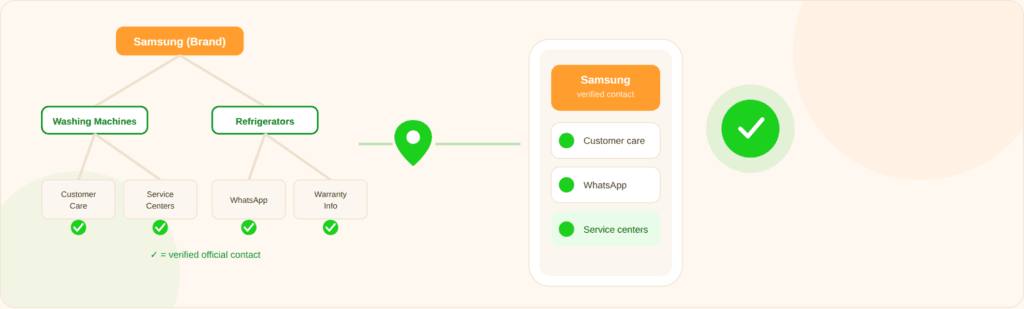
Brand → Product → Support
Samsung → Washing Machines → Support information.
Not “Home Appliances → Washing Machines → Consumer Service → Region → Channel.” That’s how the company files it internally. It’s not how anyone should have to search for it.
This is the structure behind the Simply C2 Customer Support Directory – organized by brand first, then by the product category a customer actually owns, then straight to the support information attached to it. It’s a simple hierarchy on purpose. The point isn’t to be clever about information architecture; it’s to get out of the way of the two or three clicks between “I own this” and “here’s who to contact.”
Neutrality matters
One thing worth being explicit about: a customer support directory isn’t a marketplace, and it isn’t in the business of deciding who should repair your appliance.
The first, and often only, question a directory like this needs to answer is: who made this thing, and how do I reach them? Not which of five competing local repair services should get the job, not which one is running a promotion this week. Just — the manufacturer, and the fastest legitimate route to them.
That’s a real distinction between a directory like this and the generic service marketplaces that have become common in this space. Marketplaces exist to route a job to a service provider — often for a fee, often with an incentive to prefer providers who pay to be listed. A directory exists to answer a narrower, more honest question: this is who actually made the product, and this is how you reach them directly.
It’s a smaller promise. It’s also one that’s easier to keep honestly.
But finding the number isn’t the end of the story
Here’s where it gets more interesting, though.
Say the customer support directory works exactly as intended. You find the brand, you find the product, you find the number. You make the call.
Now what?
You’ve done the hard part – the part this post and the last one have been about. But nothing about finding the right contact actually tracks what happens after you use it. The call you made, the complaint you raised, the technician who was supposed to show up – none of that lives anywhere except your own memory of the conversation and whatever notes you didn’t take.
Finding the number was never really the whole problem. It’s the first third of it. What happens after you’ve found it – and how you keep track of it – is where the next part of this series picks up.
Leave a Reply