

When your equipment is mounted on a truck, the equipment comes to you, but on wheels and on a schedule that isn’t yours. This equipment maker services around 12,000 tankers through a network of about 60 depots on Simply C2. Every truck has a home depot, and the driver talks directly to the technician.
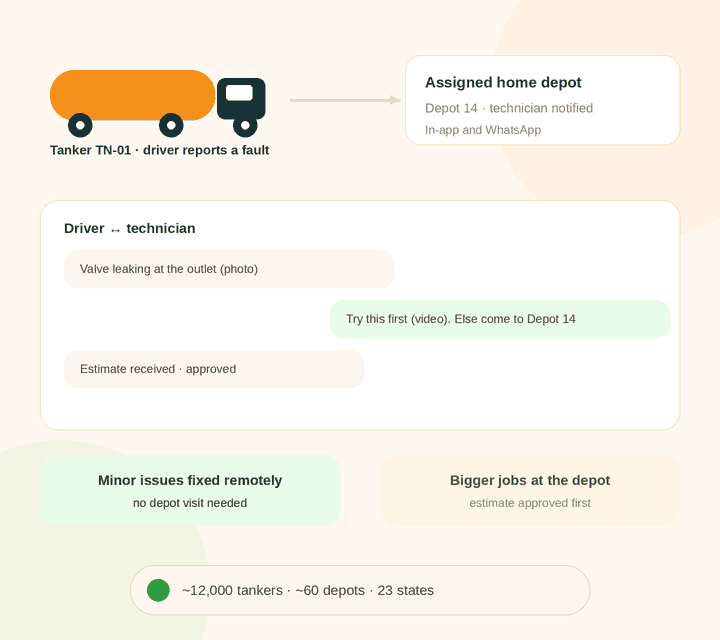
Field technicians travel to the equipment. A service centre waits for it to arrive. A depot network sits in between: the equipment moves, but each unit has a depot it belongs to.
That changes who you talk to. The person reporting the fault isn’t the owner at a desk. It’s a driver on the road, who needs an answer on his phone.
| Field service | Service centre | Depot network | |
|---|---|---|---|
| Who moves | Technician | Equipment | Equipment, on a truck |
| Where it goes | Customer site | Nearest centre | Its home depot |
| Who reports it | Site owner | Customer at the counter | The driver, on the road |
| Key metric | Response time | Turnaround time | Depot load and truck downtime |
If you don’t have a clean record of which vehicles carry your equipment, building it is part of the setup, and we do it with you.
Book a setup callWe go through your depots, the technicians at each, how trucks are assigned to depots, and your warranty terms.
Vehicles, equipment serial numbers, owners and warranty dates, from your Excel sheets or current software. You check it, then we load it.
Each vehicle linked to its home depot, your estimate and invoice formats, and WhatsApp messaging for drivers.
One named person works with you from the kickoff call until your depots are closing jobs on Simply C2.
A multinational that makes equipment for tanker trucks carrying petroleum products to retail outlets runs its repair operation on Simply C2.
~12,000
petrol and diesel tankers
~60
service depots in 23 states
1–2
technicians per depot
~50
tickets a day
The manufacturer’s equipment is fitted on tankers that carry petrol and diesel to retail outlets. Its depots handle repairs only, for trucks in warranty and out of warranty.
There are no service contracts. In-warranty repairs are covered, and out-of-warranty repairs are charged at full value. Each depot has one or two technicians, so a single absence can leave a depot uncovered.
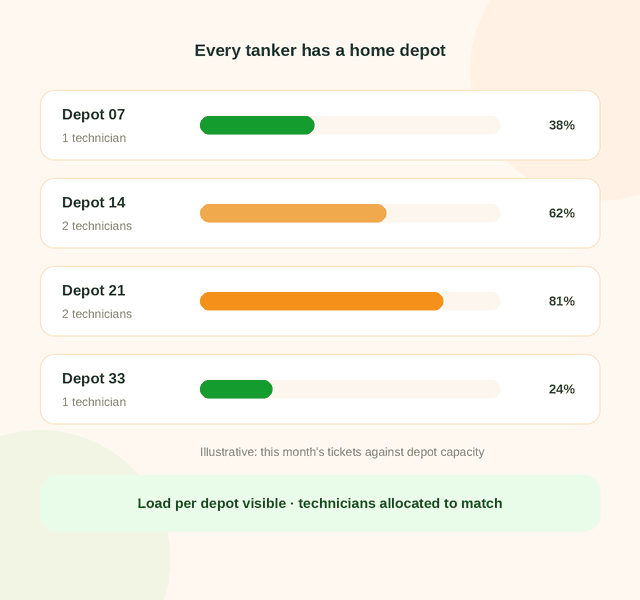
Each tanker is assigned to a designated depot. When a driver reports a fault, the ticket goes to that depot’s technician, and the driver is guided there by an in-app message and a WhatsApp message.
If the technician is away, the ticket is reassigned to another one. With every ticket tied to a depot, management can see the load on each depot and allocate technicians to match. See customer service insights.
Each tanker’s equipment is registered with its warranty status. In-warranty repairs are done under warranty. For out-of-warranty trucks, the technician sends an itemised estimate to the driver on the app and on WhatsApp before starting work.
Every spare part used is logged against the job, so owners can trust that genuine parts went in. See warranty tracking and spare parts usage tracking.
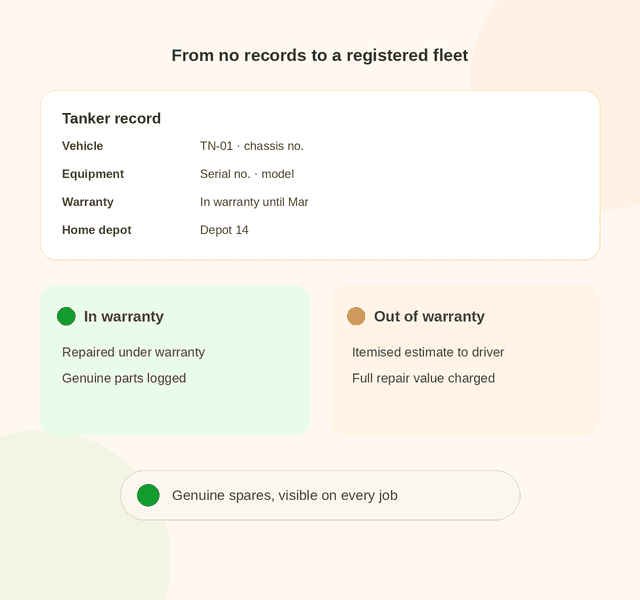
Thousands of tankers were registered in a short time, each with its equipment, warranty status and home depot. See installed base tracking.
Drivers knew which depot to go to, and depots knew what was coming. Instant notifications improved SLA compliance.
Drivers and technicians shared photos and videos on WhatsApp and the app. Minor issues were fixed remotely, with no depot visit.
With the load at each depot visible, technicians could be allocated efficiently across the network.
A bus AC or reefer service company with a handful of workshops has the same problems as this tanker network, just fewer vehicles.
Talk to our team| Lesson | Across ~60 tanker depots | At a bus AC or reefer service company |
|---|---|---|
| Give every vehicle a home | Each tanker assigned to a depot | Each bus or reefer truck linked to a workshop |
| Talk to the driver | WhatsApp and app messaging, with photos and videos | Faults reported from the road, often fixed without a visit |
| Estimate before you repair | Itemised estimate to the driver | Owner approves out-of-warranty work up front |
| Know your load | Load per depot, manpower allocated | Right technicians at the busy workshop |
| Register the fleet | Thousands of tankers registered | Every vehicle your equipment is fitted on, on record |
Technicians use the Simply C2 CRM app to see tickets for their depot, message drivers, share photos and videos, raise estimates and log spares.

No. Simply C2 doesn’t track fuel, trips or routes. It manages the service of equipment fitted on vehicles: faults reported by drivers, repairs at depots, warranty, estimates and spares.
Yes. In this case study every tanker had a designated depot. Tickets from its driver went to that depot’s technician and were reassigned if the technician was away.
On the Simply C2 app or on WhatsApp. They can send photos and videos, are guided to their home depot, and receive an estimate before work starts.
Often, yes. In this case study drivers and technicians shared photos and videos on WhatsApp and the app, and minor issues were resolved remotely.
The repair work is the same, but each vehicle belongs to a depot and the driver is the main contact. For walk-in and carry-in repairs, see service centre automation.
For a team of 20 to 50 technicians, one to two weeks, including data migration and onboarding, which are free for paid customers. Estimates, spare parts logistics and invoicing are on the Premium plan, at ₹5,000 per user per year, billed for every user. The Starter plan is free for up to 10 users. Custom dashboards, reports and other customisations are quoted separately. See license pricing.
We register your fleet, link every vehicle to its depot, and a named lead takes you through go-live in one to two weeks.