Do you run a genset service business with 20 to 50 technicians? We set Simply C2 up around your AMC terms, PM schedules and territories, and you go live in one to two weeks. We move your data in for you, and one named person from our team stays with you until your technicians are working on it.
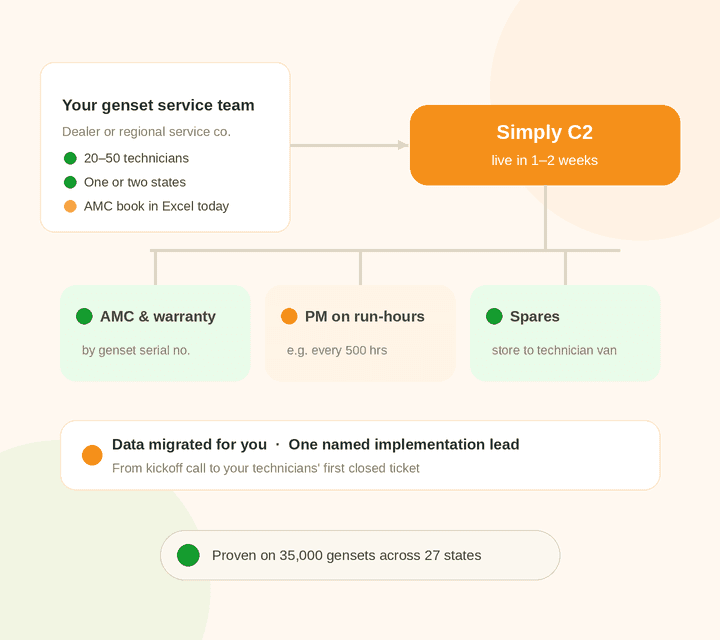
Large FSM rollouts can take months, and support after that usually means raising a helpdesk ticket. For a team of 20 to 50 technicians, we work differently.
Book a setup callWe go through your ticket types, AMC and warranty terms, territories, and who approves estimates.
We bring in your customers, sites, genset serial numbers and AMC dates from your Excel sheets or current software. You check the data, then we load it.
PM on run-hours or on a calendar, service checklists, your spares list, and your estimate and invoice formats. It’s all configuration, with no custom code.
One named person works with you from the kickoff call until your technicians are closing tickets on the app.
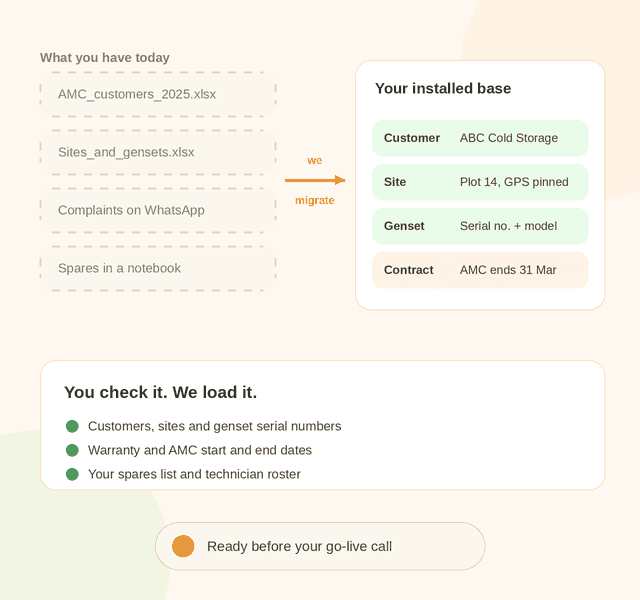
Most genset businesses keep their AMC book in Excel. We turn it into a proper equipment installed base: each customer has sites, each site has gensets, and each genset has its serial number, contract dates and full service history.
On day one, your service manager can see which AMCs expire next month and which sets are due for PM. It’s the same view the enterprise customer below had across 35,000 gensets.
This is the largest genset deployment on Simply C2. You won’t need all of it on day one. It shows that the platform will keep up as your business grows.
35,000
diesel gensets under warranty or maintenance contract
27
states covered by one service operation
~650
field technicians logging every visit on the mobile app
~1300
PM and repair tickets a day, logged 24/7
The customer is a large diesel genset manufacturer. About 35,000 of its gensets across India are under warranty or maintenance contract, and service is one of its biggest revenue lines.
Service managers run around 650 field technicians who carry out preventive maintenance and repairs. Complaints come in around the clock through a call centre, and spares are held in a central warehouse. Customer contracts set out each customer’s entitlements and the price of each service. Dealer contracts set how dealers are paid for the work they do.
We kept the core product intact and made only minimal changes. That’s why the same setup can go live quickly for a smaller team.
Every genset under contract or warranty was tracked by serial number. Sites were mapped by GPS, because many installations are remote and have no proper postal address.
At your size: your AMC book, with every set pinned on the map.
Breakdown and PM tickets came in through the call centre, the app or a customer portal. Each was assigned to the engineer for that territory, and reassigned if he was absent or overloaded. See repair tickets and scheduled maintenance.
At your size: an 11pm breakdown call reaches the right technician, not a WhatsApp group.
The central warehouse procured and stocked parts. Users at every level could raise indents or hold local stock, with live visibility of stock by part number across the country. See spare parts usage tracking.
At your size: your store and each technician’s van stock.
A dashboard set up for genset service, custom reports, alerts before contracts expire, and estimates and invoices sent through Simply C2. See customer service insights.
At your size: standard reports and the report builder cover most needs, including a monthly list of AMCs due for renewal. Custom dashboards built by our team are charged separately.
Before, matching physical stock against system stock took weeks. Now it takes a day. Management can see stock at the central warehouse, stock in transit, stock received by each technician, and parts used in repairs.
With data on fast-moving and non-moving parts, the team could set better stocking levels, cut waste and free up working capital. A dealer’s spares shelf locks up cash in the same way, only on a smaller scale.
See spare parts tracking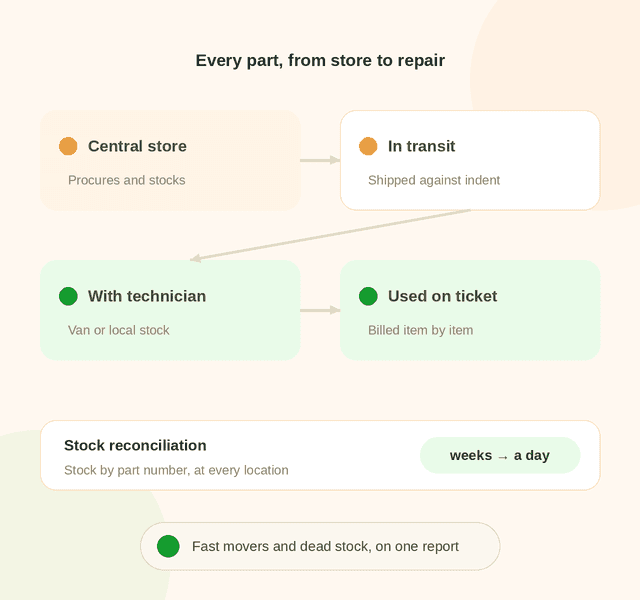
Management could see which gensets broke down often and pull up a set’s full service history at a glance. Planned overhauls and scheduled PM cut breakdowns, and spares consumption fell steadily.
Instant assignment and alerts showed technicians which tickets were most urgent. The app showed direction and distance to each site, and team and individual performance could be compared. See field service location tracking.
Each service was checked against the genset’s warranty or AMC, so no customer got free service by mistake, and everything billable was billed item by item. A monthly report of expiring contracts meant renewal proposals went out on time.
Unbilled visits, missed PM dates and spares nobody can account for cost a 30-technician dealer just as much, in proportion, as they cost a national OEM. The fix works the same way at both sizes.
Talk to our team| What it covers | At 35,000 gensets | At 20–50 technicians |
|---|---|---|
| Installed base | 35,000 sets by serial number, GPS-mapped sites | Your AMC book, migrated from Excel by us |
| Tickets | ~500 a day from a 24/7 call centre | Every call logged and assigned, with none lost in WhatsApp |
| Spares | Central warehouse to technicians in 27 states | Your store and each technician’s van stock |
| Billing | Every service billed itemwise against its entitlement | No free visits on AMCs that have expired |
| Setup | Core product intact, minimal changes | Same approach, live in 1–2 weeks |
Your technicians get assignments, directions, checklists, spares indents and invoices on the Simply C2 CRM app. In the case study, all ~650 of them logged every visit this way.

No. This case study shows the platform at its largest. It’s set up the same way for a genset dealer or a regional service company with 20 to 50 technicians.
You can set up a basic account yourself in about ten minutes. Going fully live, with your data migrated and the system set up for your process, takes one to two weeks for a team of 20 to 50 technicians. A named implementation lead works with you from the kickoff call through go-live.
Yes. Our team migrates your customers, sites, genset serial numbers and warranty or AMC dates. You review the data before it goes live. Migration and onboarding are free for paid (Premium) customers.
Yes. A PM rule can run on a fixed calendar, on logged run-hours (for example every 500 hours), or be triggered after an event. See scheduled maintenance tickets.
Yes. Each genset is its own record with its own make, model, contract and history, so a multi-brand AMC book works fine. See third-party maintenance software.
The Starter plan is free for up to 10 users. Above that, the Premium plan is ₹5,000 per user per year, billed for every user, and it includes preventive maintenance and spare parts logistics, which genset service teams usually need. Data migration and onboarding are included at no extra cost; custom dashboards and custom reports built by our team are quoted separately. See license pricing, or sign up free to look around first.
We migrate your data and a named lead takes you through go-live. Start with a call on WhatsApp.