

Simply C2 runs repair, preventive maintenance and calibration for about 110,000 fuel dispensers at some 70,000 petrol pumps. If you look after a spread-out fleet of metered equipment, such as EV chargers, solar pumps, CNG dispensers or weighbridges, this is the playbook you need, sized for a team of 20 to 50 technicians.
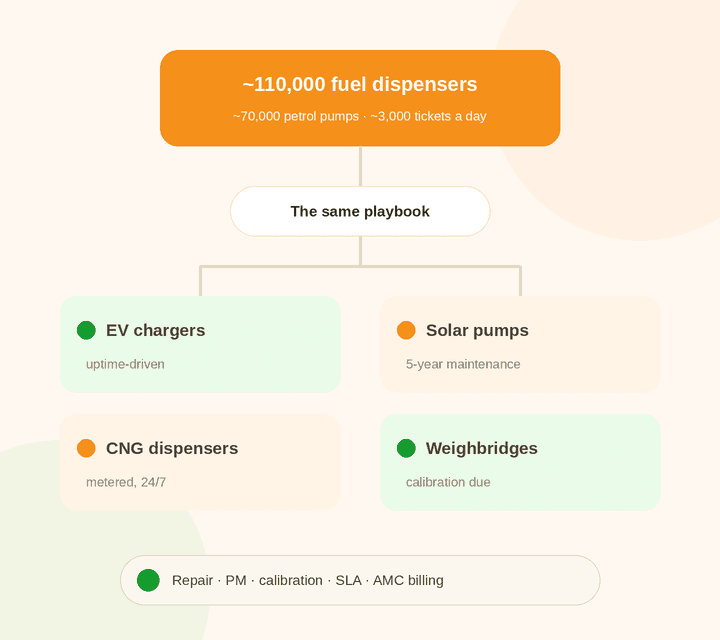
~110,000
fuel dispensing units under maintenance
~70,000
petrol pumps across India
~3,000
tickets a day
24/7
complaint logging, under strict SLAs
Few businesses maintain fuel dispensers. Many maintain equipment that behaves the same way. If three or more of these describe your work, the playbook carries over.
The same equipment at thousands of sites, many on highways or in villages with no proper postal address. Every unit needs a serial number, a GPS-pinned site and a history. See installed base tracking.
The dealer runs the pump, but a manufacturer or contractor maintains the dispenser. The site owner logs the complaint and needs to see it through to closure.
A dispenser measures what the customer pays for. Calibration is a ticket type of its own, alongside repair and PM. See scheduled maintenance tickets.
A dispenser that’s down loses sales every hour. Complaints come in around the clock, and SLAs are strict.
Some jobs are covered by warranty or AMC, and some are billable. Each one has to be checked, estimated and invoiced correctly. See warranty and AMC tracking.
India has over 29,000 public charging stations and more than 200 charge point operators, and public chargers are expected to maintain 98% monthly uptime. Chargers are metered, spread out and judged on uptime, like dispensers.
What carries over: 24/7 complaint logging from site hosts, SLA tracking on every ticket, PM schedules per charger model, and billing against the service contract.
Lakhs of standalone solar pumps have been installed under PM-KUSUM. The vendor carries a five-year maintenance cover for each one, often on a remote farm.
What carries over: farm sites pinned by GPS, a complaint from the farmer tracked to closure, and geo-tagged proof of every visit across the maintenance period.
India has more than 9,000 CNG stations. Their dispensers and compressors are the closest equipment match to fuel dispensers.
What carries over: nearly everything. Repair, PM and calibration tickets, 24/7 logging, and spares tracked by part number.
Like fuel dispensers, weighbridges measure what someone pays for. That makes calibration a regular, scheduled job, alongside repairs.
What carries over: calibration as its own ticket type with its own form, scheduled automatically, next to repair tickets.
Figures: Ministry of Heavy Industries data on EV charging (via Business Standard, 2026); PNGRB city gas distribution data (June 2026); MNRE PM-KUSUM scheme.
You won’t need a 110,000-unit rollout plan. For a team of 20 to 50 technicians, we set up the same building blocks in one to two weeks.
Book a setup callWe go through your equipment models, sites, contract types, the SLAs you owe, and how often units need PM and calibration.
Site lists, units by serial number, and warranty and AMC dates, from your Excel sheets or current software. You check it, then we load it.
Repair, PM and calibration, each with its own form, plus your estimate and invoice formats.
One named person works with you from the kickoff call until your technicians are closing tickets on the app.
The petrol pumps are run by dealers, franchisees of the oil companies. The fuel dispensers at those pumps are maintained under warranty and AMC by our customer.
The work covers repair, preventive maintenance and calibration, with complaints logged 24/7 under strict SLAs. Spare parts come from a central warehouse, and a large field workforce covers the country.
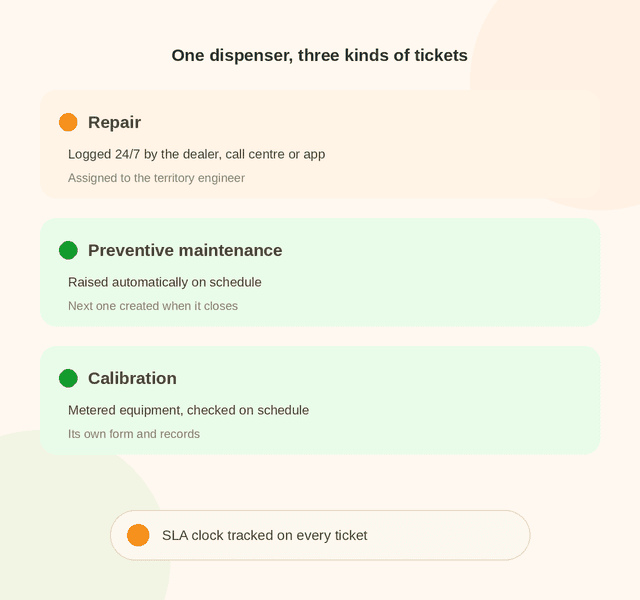
Dealers could log a complaint through the customer portal, the mobile app or the call centre, at any hour. Each ticket went straight to the engineer who covers that territory, and managers could reassign it if needed.
PM and calibration ran as scheduled ticket types, next to repair. Every dispenser was tracked by serial number, and sites were pinned by GPS, because many pumps don’t have a proper postal address. See repair service management.
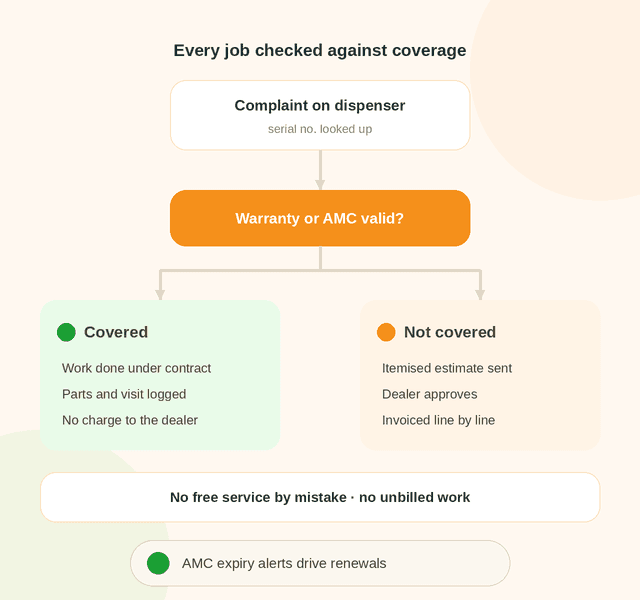
Before any work was billed, Simply C2 checked the dispenser’s warranty and AMC. Covered work was done under contract. Anything out of warranty or outside the contract got an itemised estimate for parts and labour.
Dashboards were set up for this operation, alerts flagged contracts nearing expiry, and estimates and invoices went out through Simply C2. See customer service insights.
Instant assignment and notifications meant tickets were picked up and closed faster, with the loop closed with the dealer. See field service location tracking.
Better scheduled maintenance improved asset health, and spare parts consumption went down. See spare parts usage tracking.
Itemised estimates and coverage checks meant no free service by mistake and no unbilled work. Dealers could see what they were paying for, which built trust.
Alerts on contracts nearing expiry meant renewal proposals went out on time, and more AMCs were renewed.
You don’t need 110,000 units to have these problems. A 20 to 50 technician team looking after a few thousand chargers or pumps has them from day one.
Talk to our team| Lesson | On ~110,000 dispensers | EV charger fleet | Solar pump vendor |
|---|---|---|---|
| Let site owners log complaints | Dealers log 24/7 via portal, app or call centre | Site hosts report a charger that’s down | Farmers report a pump that won’t run |
| Pin every unit to a site | GPS sites where there’s no postal address | Highway and parking-lot chargers | Farm locations |
| Schedule the routine work | PM and calibration tickets | PM per charger model | Periodic checks through the maintenance period |
| Check coverage before billing | Warranty and AMC checked on every job | Service contract per site | Five-year maintenance cover per pump |
| Track the SLA | Strict SLAs across the network | Uptime targets | Response times to farmers |
Your technicians get assignments, directions, checklists, estimates and invoices on the Simply C2 CRM app, and log geo-tagged photos and spares used at the site.

No. The petrol pump deployment is our largest, but the same setup fits any spread-out fleet of similar equipment: EV chargers, solar water pumps, CNG dispensers, weighbridges and more.
Yes. Calibration is its own ticket type with its own form, scheduled automatically. See scheduled maintenance tickets.
Yes. In the petrol pump deployment, dealers logged complaints 24/7 through the customer portal, the mobile app or the call centre, and each ticket was assigned to the engineer for that territory.
Each unit is tracked by serial number with its warranty or AMC. Covered work is done under contract; anything else gets an itemised estimate for the customer to approve. See warranty and AMC tracking.
Yes. Each pump can be tracked by serial number and farm location, with its maintenance period, complaints from farmers, and a geo-tagged record of every visit.
For a team of 20 to 50 technicians, one to two weeks, including data migration and onboarding, which are free for paid customers. The Premium plan, which includes preventive maintenance and spare parts logistics, is ₹5,000 per user per year, billed for every user. The Starter plan is free for up to 10 users. Custom dashboards, reports and other customisations are quoted separately. See license pricing.
We migrate your sites and units, set up repair, PM and calibration, and a named lead takes you through go-live.