

A “No” Needs a Reason: What Warranty Rejections Teach About Paperwork
A warranty rejection is a moment in after-sales service when the customer hears a flat “no” on something they paid for. Whether that “no” survives a consumer commission scrutiny depends on the documentation backing the decision.
Recent commission orders in India display both perspectives. In some, the rejection was upheld. In others it was not. The difference was usually in the record-keeping.
Two rejections that held, and two that didn’t
In Himachal Pradesh, a State Commission, in February 2026, upheld the dismissal of a complaint about a fold-able phone bought for ₹83,990. The screen had been replaced free of cost under a protection plan in 2021. When the display was damaged again in 2022, the repair estimate was ₹29,769 and the company declined a second free repair, citing the plan’s one-replacement-a-year limit. The commission relied on photographs of the device and the repair records, found damage consistent with external pressure, noted that no expert opinion supported a defect claim, and found no deficiency in service.
In Delhi, (reported in June 2026) a district commission held a carmaker liable for deficiency in service. Three of four tyre-pressure sensors in a car under warranty were faulty, and the owner was charged ₹3,000 for the replacement. The commission observed that the manufacturer never carried out a proper technical examination of the faults, even though the vehicle stayed at its service centre, and it found the claim that the owner had refused inspection to be false.
In Haridwar (reported in September 2026) a service centre’s online check showed a phone’s warranty had expired on 14 November 2023, and it declined the repair. The owner had approached it ten days later. The commission found the phone had been sold with a pre-activated warranty, held the dealer liable, and found no deficiency by the service centre or the manufacturer.
And in a Delhi order reported in October 2025, a smartphone with defects within days of purchase was refused a replacement or refund even though the company had its own “Dead on Arrival” policy. The commission ordered a refund of ₹30,999, the full purchase price.
Note, each case was decided on its own facts, and none sets a rule for every dispute.
What the four have in common
Every time, the outcome followed the evidence. Where the company had photographs, repair records and a clear plan term, the rejection stood. Where the technical examination was missing, the start date was wrong or the company’s own policy wasn’t followed, it didn’t.
Five lessons for service teams
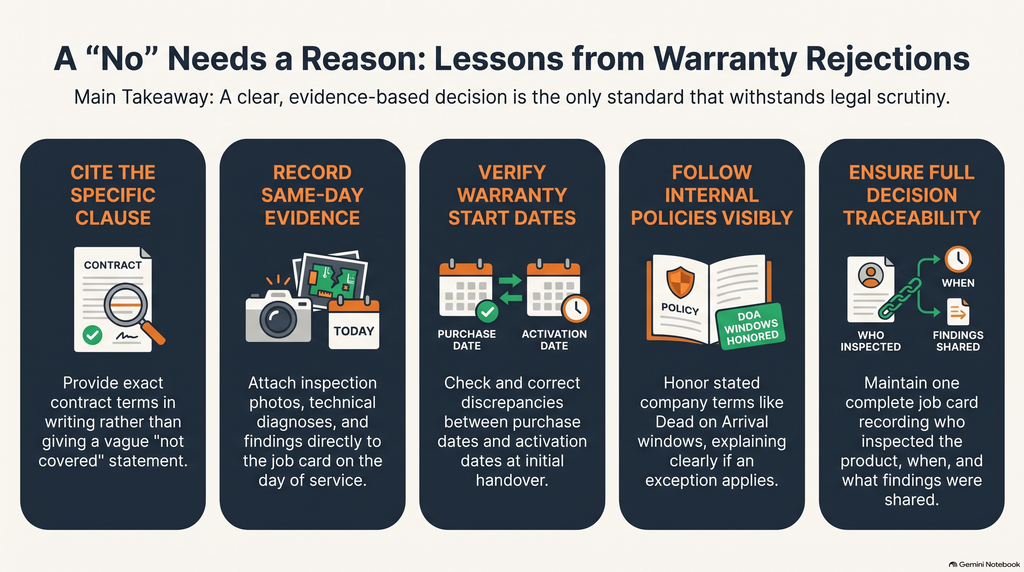
1. Put the reason in writing, with the clause. “Not covered” is a conclusion, that sounds like someone’s opinion. “Not covered under clause X because Y” is a decision a customer can check, and a commission can too. The person making the call confirms that the clause actually applies before conveying to the customer.
2. Record the evidence at the time. Photographs, the diagnosis and the technician’s findings belong on the job card on the day the product is inspected. The Himachal Pradesh outcome rested on such records. Whereas, the Delhi one turned on their absence.
3. Check the warranty start date at handover. The Haridwar dispute began with an activation date that didn’t match the purchase date. A date error caught on the first service request is a one-line correction. Caught in a hearing, it isn’t. Where a dealer activates the warranty, agree in advance who corrects the record when the dates differ.
4. Follow your own policy, visibly. A written policy such as a replacement window for products that are dead on arrival is a promise. If a case falls outside it, say why and cite the term.
5. Make the decision traceable. Who inspected, when, what they found and all customer communication should be visible on one job card, whoever picks up the case next. Service centre automation is about exactly this kind of process: the same steps, recorded the same way, every time.
If your claim is rejected
- Ask for the reason and the clause in writing, and keep the job card.
- Photograph the product and note the dates of purchase, activation and each service request.
- If you disagree, the National Consumer Helpline (1915) is a free first route, and the district consumer commission is the formal one. (Our earlier post on repeat repairs covers both routes.)
- This is general information, not legal advice.
The takeaway
A rejection is still strong after you explain it. A clear, documented “no” gives both sides the same facts to work from, which is the best starting point for settling a disagreement early, and the same applies to a “yes.” The strongest warranty decisions in these cases were not the firmest ones. The ones with the best documentation were the strongest.
Leave a Reply