

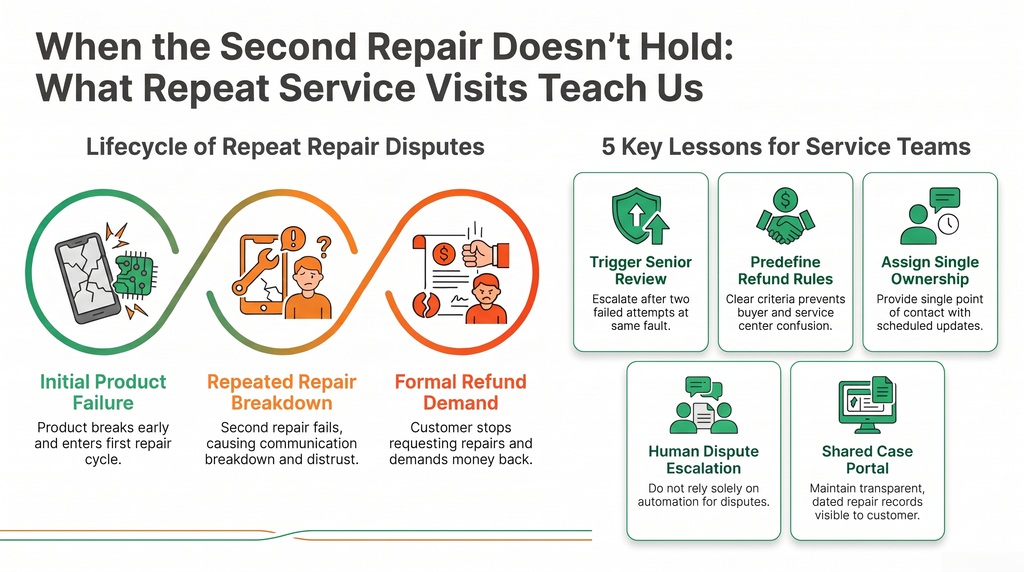
Repair, Replace or Refund? Decide Before the Dispute
Most service complaints begin with a broken product. The root of the escalations lies in the repeat service visits; definitely beyond the 2nd. The ones that end up before a consumer commission usually begin with the second fruitless visit.
Across this week’s reading of public complaint posts, news reports and recent consumer-commission orders in India, one recurring theme. A product fails early. A tech visits for repair. Within a month, he is back because it failed again. By the third visit the customer is no longer asking for a fix. They are asking for their money back, and they are putting it in writing.
We studied recent cases from public news sources- especially ones that have landed in the consumer court.
What recent consumer court orders describe
Three orders show how this plays out. Each was decided on its own facts, and none sets a rule for every case.
A district commission in Belagavi, Karnataka, looked at a bus bought for ₹16 lakh. The buyer said it developed engine overheating, coolant leakage and engine seizure within about two months and roughly 9,000 km. The commission noted the problems continued despite repairs, and directed the manufacturer and dealer to replace the vehicle or refund ₹15 lakh with 6% interest.
In Kangra, Himachal Pradesh, a commission treated repeated timing-belt failures in an SUV as an inherent defect and ordered a replacement or a refund of about ₹21.4 lakh. The manufacturer disputed this, pointing out that the vehicle had covered more than 30,000 km in roughly 25 months.
The pattern isn’t limited to vehicles. In a 2025 order from Chandigarh, a TV’s panel defect was acknowledged, and the replacement panel was also faulty. The manufacturer’s position was that its warranty covered repair or part replacement, not a refund, and it offered ₹74,990 in coupons. The commission found that insisting on coupons instead of a cash refund was unfair, and ordered ₹79,980 with 9% interest.
What the complaint posts add
Public complaint posts (on X) are one side of the story and are unverified, but they echo these cases. A recurring theme this week: three visits for one fault; a replacement approved but not delivered for weeks; a paid service plan where days passed with no technician visit and no callback. The common thread is not only the defect, or even the repeat service visits. It is the silence between visits, and the sense that nobody owns the case from one visit to the next.
Five lessons for service teams: how to handle repeat service visits
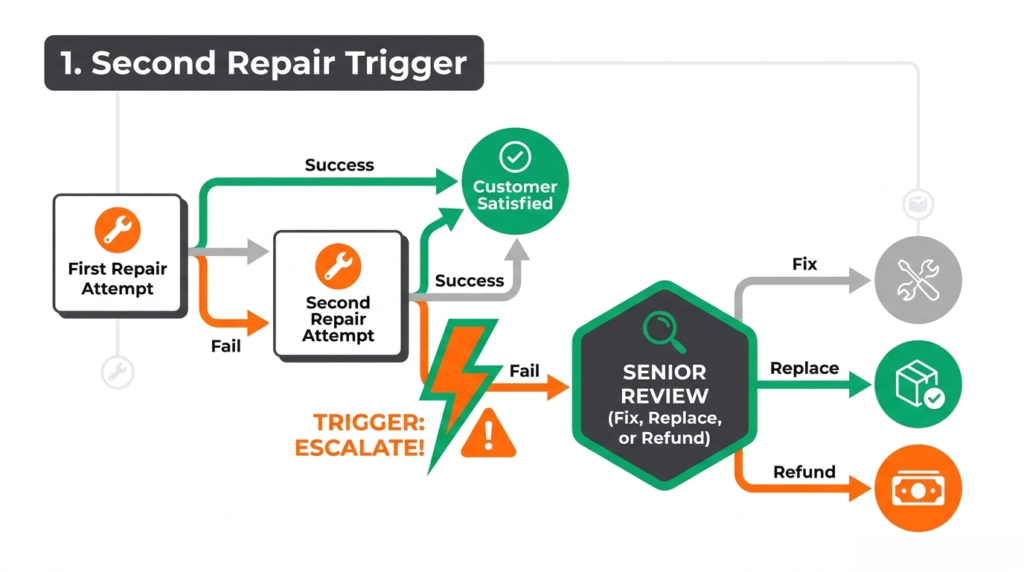
1. Treat the repeat service visits as a trigger. Decide in advance that two attempts at the same fault moves the case to a senior review that chooses between repair, replacement and refund. A third identical visit rarely produces a different result.
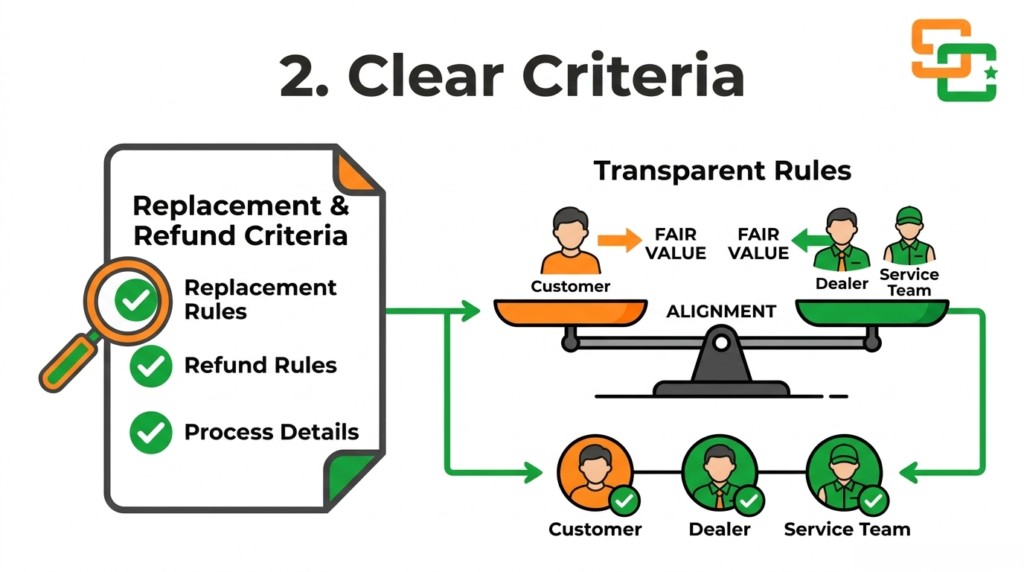
2. Write down your replacement and refund criteria before a dispute. When the customer, the dealer and the service centre each assume a different rule, the customer meets all three versions. A remedy also has to be usable: the Chandigarh case turned on the form of the refund, not only the amount.
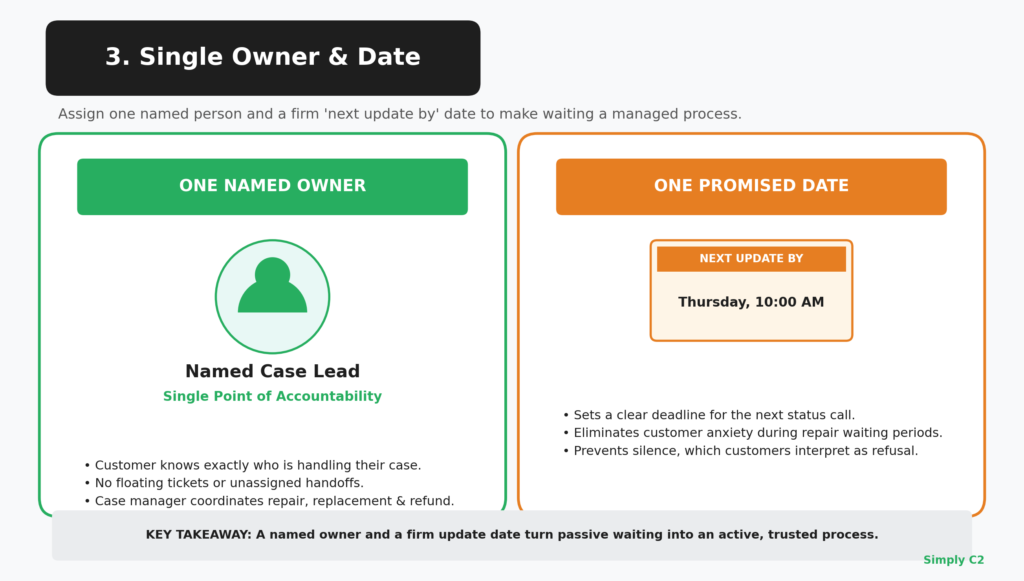
3. Give every case one owner and one date. A named person and a “next update by” date turn waiting into a process. Even “we are waiting on a part, and we will update you on Thursday” is better than nothing, because the customer reads silence as refusal.
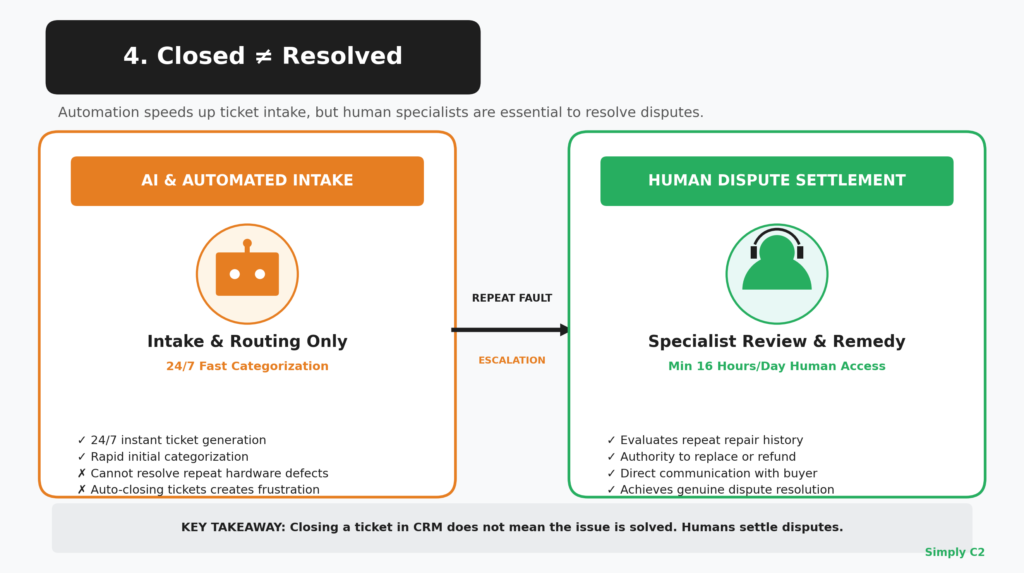
4. Moreover, closed is not resolved. In November 2026, TRAI issued telecom complaint rules that allow AI agents round the clock but require human assistance for at least 16 hours a day, disclosure when a customer is talking to an AI, and financial penalties for mishandled complaints. That is a different sector, but the direction is clear. An EY India report found that only 23% of companies get high value from AI in customer service. Automation can speed up intake; it does not settle a dispute.
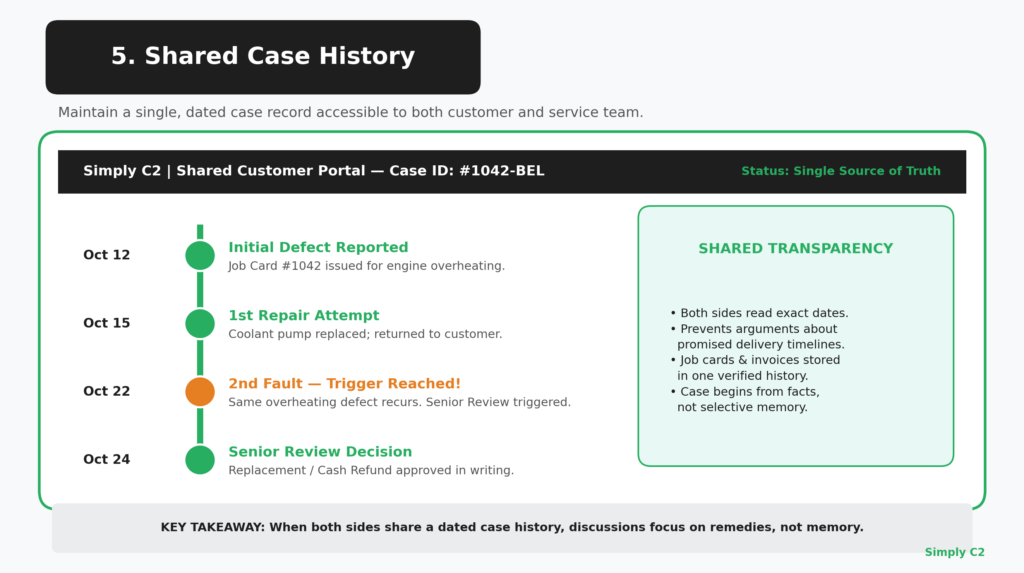
5. Keep a record both sides can read. Most arguments about repeated repairs are arguments about dates: when it was reported, when it was collected, what was promised. A customer complaint portal is one way to hold a single, dated case history that the customer and the company can both refer to, so the discussion starts from the same facts.
If you are the customer
- Keep every job card, invoice and warranty document, and note the date of each visit and what was promised.
- Complain in writing and keep the acknowledgment. A phone call leaves no trail.
- The National Consumer Helpline (1915) is a free first route. If that doesn’t work, formal complaints go to the district consumer commission through the e-Jagriti portal, generally within two years of the problem arising.
- This is general information, not legal advice. A lawyer or consumer organization can advise on your case.
The takeaway
A repair that needs repeat service visits is a signal that the problem has changed from a technical one to a trust one, and that the customer is now counting visits, not just watching the product. Companies that notice it early and customers who keep clear records give both sides the best chance of settling the matter before it becomes a legal one.
Sources
- Belagavi bus order (replace or refund ₹15 lakh): https://www.livelaw.in/consumer-cases/new-bus-suffers-engine-overheating-seizure-within-2-months-belagavi-consumer-commission-orders-replacement-or-refund-553626
- Same order, second report: https://lawchakra.in/other-courts/belagavi-consumer-commission-bus/
- Same order: https://timesofindia.indiatimes.com/legal/news/consumer-court-orders-replacement-or-rs-15-lakh-refund-after-force-motors-vehicle-developed-engine-defect-within-2-months-of-purchase/articleshow/134965140.cms
- Kangra SUV order (22 Jun 2026): https://www.livelaw.in/consumer-cases/tata-harrier-owner-gets-relief-in-consumer-case-tata-motors-asked-to-replace-defective-car-or-refund-214-lakh-refund-538547
- Chandigarh TV order (10 Nov 2025): https://www.livelaw.in/amp/consumer-cases/chandigarh-consumer-commission-holds-samsung-liable-for-defective-led-tv-orders-refund-and-compensation-309417
- TRAI complaint redressal rules, 2 Nov 2026: https://egov.eletsonline.com/?p=107435
- TRAI rules, human support, AI disclosure: https://lapaasvoice.com/trai-mandates-24×7-ai-complaint-centres-16-hour-human-support/
- TRAI penalties for improperly closed complaints: https://odishabytes.com/trai-notifies-stricter-guidelines-for-operators-improperly-closed-complaints-to-attract-penalties/amp/
- EY India report on AI in customer service: https://bestmediainfo.com/insights/only-23-of-companies-get-high-value-from-ai-in-customer-service-ey-india-report-12783233
- National Consumer Helpline and e-Jagriti: https://ianslive.in/national-consumer-day-nch-e-jagriti-platforms-ensure-timely-grievance-redressal–20251223135215
- Two-year filing window: https://righttoinformation.wiki/_export/xhtml/complaints/consumer-complaint-edaakhil
Leave a Reply