

An escalation matrix is easier to copy than to invent. Below are three examples for different kinds of service business. All names, roles and time limits are fictitious. We intend to show the paradigm; set yours to match what you can actually deliver. For the basics, see what an escalation matrix is and the format.
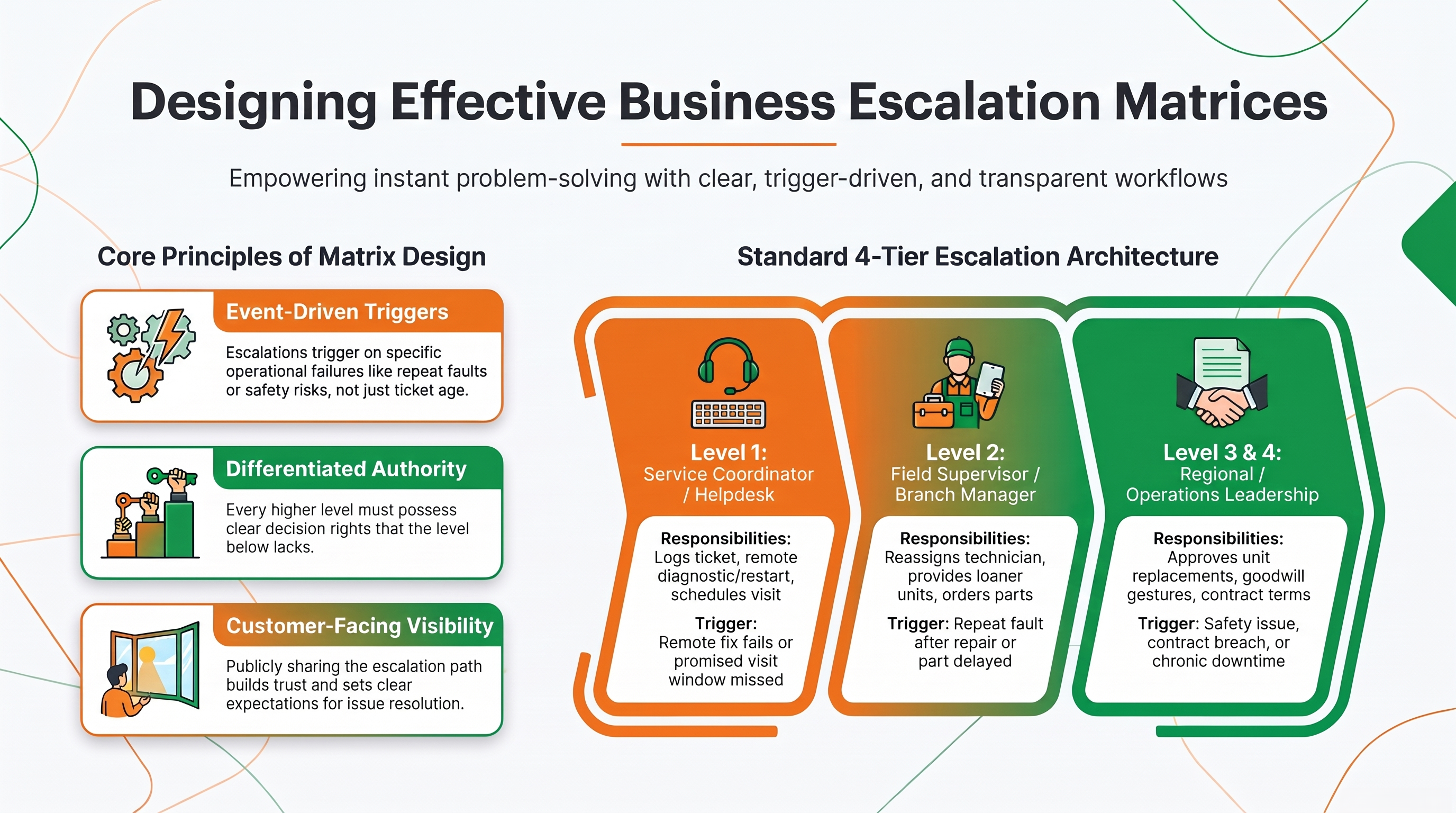
Example 1: an appliance service centre (water purifiers and ACs)
| Level | Role | Handles | Moves up if |
|---|---|---|---|
| L1 | Service coordinator | Logs the complaint, books the visit, confirms the warranty status | The visit has not happened within the promised window |
| L2 | Branch service manager | Reassigns the technician, orders a part, approves a second visit | Same fault after a repair, or a part delayed beyond its estimate |
| L3 | Regional service head | Approves a replacement unit or a goodwill gesture | A safety issue, or two failed repairs |
| L4 | Customer care head | Final internal decision | Last internal level |
Why it works: the “same fault after a repair” trigger moves repeat failures up without waiting for the clock. Related: warranty management software.
Example 2: a CCTV and security-camera installer
| Level | Role | Handles | Moves up if |
|---|---|---|---|
| L1 | Support desk | Takes the call, remote checks, books a technician | Cameras down and no visit scheduled the same day |
| L2 | Site supervisor | Sends a senior technician, arranges a loan unit | Site still without recording after the first visit |
| L3 | Operations head | Decides on replacement of equipment, reviews the AMC terms | The customer has an AMC and has been without recording longer than the contract allows |
Why it works: the trigger is “no recording”, not “ticket age”, because that is what the customer cares about. Check that your own AMC terms define the response time; do not copy the example’s. See AMC management software.
Example 3: an EV charging network operator
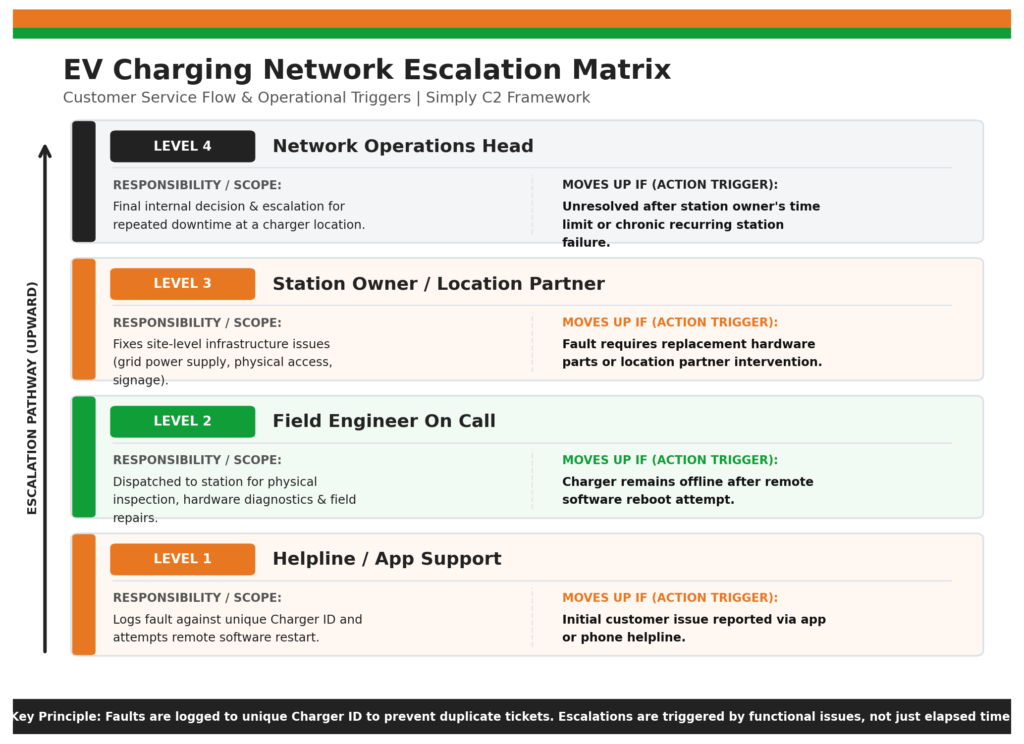
| Level | Role | Handles | Moves up if |
|---|---|---|---|
| L1 | Helpline / app support | Logs the fault against the charger ID, tries a remote restart | Charger still down after the remote restart |
| L2 | Field engineer on call | Visits the station | Fault needs a part or the station owner |
| L3 | Station owner or location partner | Fixes site issues (power, access, signage) | Unresolved after the owner’s time limit |
| L4 | Network operations head | Escalation for repeated downtime at one location | Last internal level |
Why it works: the charger ID is the key, so the same station problem is not reported as ten separate complaints. The customer-side route (station feedback goes to the lowest level that can actually solve it) is how Simply C2’s station finder routes feedback for petrol pumps and EV charging stations.
What the three have in common
- Each level can decide something the level below cannot.
- There is a trigger other than time (repeat fault, safety, “no recording”).
- The customer can see the path, not just the staff.
- Roles are listed, with a named backup per level.
Make yours
Download the free escalation matrix template (Excel) and replace the example row. If you also want complaints to arrive as tickets with an owner and a clock, see how the customer complaint portal works; the free Starter plan covers up to 10 users, no credit card: Start free.
Internal links: escalation-matrix, warranty-management-software, amc-management-software, customer-complaint-portal, complaint-register-format, escalation email post.
Leave a Reply