

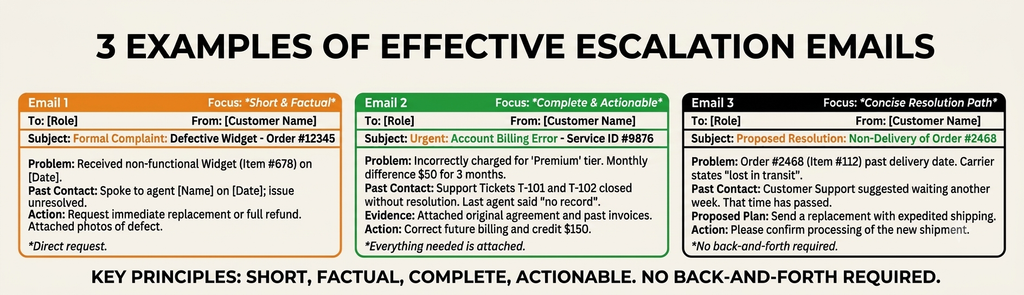
When a brand has not solved your complaint, the next step is usually an email to someone more senior. A good escalation email is short, factual and complete, so the person reading it can act without writing back to ask for details. This post gives a format and three examples for common situations in India.
Before you write that escalation email
- Find the right person. Look for the brand’s escalation contacts: the support page, the warranty card, the grievance officer or nodal officer if the brand lists one, or the brand directory. Smaller brands may list only one or two levels. See the escalation matrix for how the levels usually work.
- Collect what you have. Original ticket number, dates of each contact, the product model and serial number, the invoice, and any photos.
- Wait for the brand’s own time limit if they stated one. Escalating on day two of a seven-day promise usually just restarts the clock.
The format
Subject: Escalation: Ticket [number] for [product], unresolved since 2026
- Opening line: who you are, the ticket number, the product and the date you first complained.
- What happened: two or three sentences, dates in order. State facts, not feelings.
- What you have already tried: each contact with date and channel.
- What you want: one clear request (repair, replacement, refund, a call-back) and a date by which you would like a reply.
- Attachments: invoice, warranty card, photos, earlier replies. Name the files.
- Sign-off: name, phone, and the address of the product if a visit is needed.
Example 1: a repair visit that did not happen
Subject: Escalation: Ticket SR-10234 for water purifier, no visit since 2 November
Dear Service Head,
I am writing about ticket SR-10234, raised on 2 November for a water purifier (model and serial number below, purchased on 14 June, in warranty). The purifier stopped giving water on 1 November.
A technician visit was promised within three working days. However, no one has visited and no one has called since 4 November. I phoned the helpline on 5 and 8 November and was told the ticket was “in process”.
I request a technician visit by 18 November, or a call from you to give me a date. Invoice and warranty card are attached.
Regards, [name], [phone], [address]
(Invented details. Replace every bracketed and example value.)
Example 2: the same fault again after a repair
Subject: Escalation: Ticket SR-20871 for refrigerator, same fault after repair
Dear Customer Care Head,
Ticket SR-20871 relates to a refrigerator [model, serial] with a cooling fault. It was repaired on 10 October and the fault returned on 3 November. This is the second visit for the same fault within the warranty period.
I request that the company inspect it again, since the repair did not work. If the inspection points to a product defect, this should be replaced. Please reply by 20 November. Invoice, the 10 October job sheet and a photo are attached.
Regards, [name], [phone]
(Invented details.)
Example 3: a refund that was promised
Subject: Escalation: Order [number], refund promised on 28 October not received
Dear Grievance Officer,
Order [number] for [product] was returned on 25 October. On 28 October your team confirmed by email that a refund would be made within seven days. As of today it has not arrived. My earlier contacts: chat on 2 November, email on 5 November (copies attached).
Please confirm the refund date in writing by 20 November.
Regards, [name], [phone]
(Invented details; confirm what the brand actually promised before you quote it.)
What to avoid
- Long background stories and several different requests in one email.
- Threats you do not intend to carry out.
- Quoting laws you have not read. A first escalation does not need to cite any law. If two emails go unanswered, the National Consumer Helpline or the consumer forum are the next routes.
- Sending it to many people at once with no ticket number.
If the brand does not reply
Wait for the stated time, then send one follow-up to the next level in the matrix, quoting the first email. Keep copies of everything.
Get help drafting it
Simply C2’s free complaint escalation service turns your ticket details into a formatted email. You review it in your own email account and send it yourself; Simply C2 does not send it for you and does not take sides. It works for any brand, but the brand’s own ticket number is needed. Nodal and service-head contacts exist for many major brands and may not exist for smaller ones.
For service teams
If you run a service team, published escalation paths and complaints need to arrive as tickets in your CRM matter: an escalation email usually begins with a customer who has heard nothing.
Leave a Reply