

Finding Customer Support Shouldn’t Be a Treasure Hunt
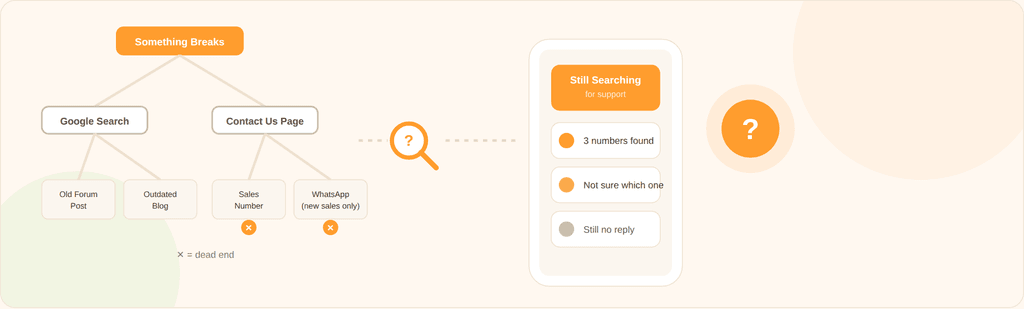
The moment something goes wrong
The time to find the customer care number is then.
“That AC has stopped cooling.”
“My washing machine is leaking.”
“My car is showing a warning light I don’t recognize.”
“I need to claim the warranty on my water purifier.”
In that moment, nobody is thinking about the company that made the product. They’re not curious about its org chart, its regional service structure, or which department handles which category. They have one thought: I need this fixed, and I need to know who to call.
That single, simple need – find customer care number, now – is where every customer support experience actually begins. And it’s also where most of them start to go wrong.
The treasure hunt begins: to find customer care number
Here’s what actually happens next, for almost everyone, almost every time:
- Search Google for the brand name and “customer care.”
- Land on the manufacturer’s website.
- Hunt for a “Contact Us” link, usually buried in the footer.
- Find not one phone number, but three.
- Wonder which of the three is for service, and which is for sales inquiries that will go nowhere.
- Spot a WhatsApp number, feel a flicker of relief.
- Discover it’s only for pre-sales questions about buying a new product — not the one that’s already broken.
- Go back to Google.
- Try again.
We’ve written before about how often a company’s support information is hiding in plain sight – technically published somewhere, practically impossible to use in the moment you need it. This is that problem in motion: a scavenger hunt that starts the moment something breaks, at precisely the time a customer has the least patience for one.
The information isn’t missing – it’s fragmented
It would be easy to conclude that companies simply don’t publish their support details. However, that’s rarely true. Most manufacturers do have a service number, a support email, a warranty policy, a list of authorized centers – somewhere.
The real problem isn’t absence. It’s fragmentation.
The service number for washing machines isn’t the same as the one for refrigerators. The warranty terms live on a different page than the service-center locator. The WhatsApp line handles some queries but not others, and nobody tells you which.
Each piece of information is technically correct and technically find-able – but only if you already know where to look, and most people don’t, because they’re not company insiders. They’re customers, and they usually have exactly one product from exactly one brand, encountered exactly once a year, if that.
That’s an important distinction, because it changes what the actual fix looks like. This isn’t a case of companies withholding information and needing to publish more of it. It’s a case of information that exists but isn’t organized around the person trying to use it.
Customers think differently from companies
Here’s the mismatch at the heart of it.
A customer thinks: “I have a Samsung washing machine.”
A company’s internal structure thinks: “Home Appliances → Washing Machines → Consumer Service → Region → Channel.”
Both of these are reasonable ways to organize information. But only one of them is how the person holding a leaking washing machine at 8 PM on a Sunday actually thinks. Companies build their websites, support hierarchies, and call-routing systems around how they are organized internally – by product division, by region, by department, by channel. That’s a sensible way to run a company. It is not a sensible way to help someone find a phone number in a hurry.
The customer shouldn’t have to learn a manufacturer’s org chart just to report a problem. And yet, in practice, that’s often exactly what the current version of “customer support” demands of them — decode the company’s structure, then map their own simple need onto it.
What if support were organized around the customer instead?
This is really the only question that matters: what if there were a place organized the way customers actually look for help, rather than the way companies are organized internally?
Not “Home Appliances → Washing Machines → Consumer Service → Region → Channel.”
Just: Brand → Product → Support.
Three steps. The brand you own, the product you own, and the support information attached to it: official numbers, WhatsApp lines, email addresses, service-center details — collected in one place, without requiring anyone to guess which of three phone numbers is the right one, or refresh a company’s outdated contact page from three years ago.
That idea: support information organized around how customers actually search, not how companies are internally structured – is one of the reasons we’re building the Simply C2 Customer Support Directory.
It won’t replace the manufacturer’s own support team, and it isn’t a shortcut around the actual repair. What it can do is remove the treasure hunt that currently sits between “something is broken” and “I know who to call” – which, for most people, is the first and most frustrating part of the whole ordeal.
And, yes, do check out what we have for the Samsung Washing Machine customer support. Or, for that matter, for Bosh front load washing machine.
That’s where we’ll pick up next: not just organizing support information sensibly, but what a genuinely useful directory needs to contain, and why that’s a harder question than it first appears.
Leave a Reply