Solving India’s EV Charging Chaos
Thousands of Indians are switching to an EV every month. They are lured by smooth, silent driving, and the feeling that they’re part of a greener future. But by 2026, many Indian EV owners are asking a frustrating question: Why is planning a road trip still so painful?. India’s EV market is growing at a massive rate—with a vehicle population of over 2.1 million and a 30% growth rate. But, the “software side” of charging feels like a digital jungle.
Let’s focus on the software side of the EV charging chaos: at why this is happening, what other countries are doing, and the “UPI-style” solution India is building to fix it.
EV Charging Chaos: 20 Apps for One Car?
Imagine if every time you needed petrol, you had to check five different apps to see which station was open, and each one required you to keep a separate “wallet” with ₹500 pre-loaded. That is the reality for Indian EV drivers today. In 2026, it is common for a single driver to navigate 17 to 20 different mobile applications just to find and pay for a working charger on a long trip.
The EV charging chaos is not only the number of apps; it’s the lack of standards. Most of these apps operate in “closed loops”. You might pull up to a charger, top up a specific wallet, only to find the charger doesn’t work, and the next available station is run by a different operator who won’t accept that balance. This fragmentation leads to “charging anxiety”—the fear that while you can see a charger on a map, you won’t actually be able to use it when you arrive.
The Reliability Gap: Presence vs. Performance
Another major pain point is that “on the map” doesn’t mean “ready to charge”. As of early 2024, nearly half of all public chargers in India—about 12,100 units—were reported as non-functional. Some are broken due to technical faults, while others are victims of simple power cuts.
Because there isn’t a single standard for reporting “live” data, an app might tell you a charger is “Available,” but when you arrive, you find it’s being used by another car or the connector is worn out. In more mature EV markets, strict rules are helping to close this gap.
What the Rest of the World is Doing
India isn’t alone in facing EV charging chaos, but other regions are a few steps ahead in setting standards:
- The United Kingdom: The UK government published a “Plan for Drivers” in 2023 that focuses on making public charging more transparent. They’ve introduced regulations requiring public chargers to have clear pricing and “ease of payment” across all networks.
- California: As the EV leader in the US, California has standardized Level 2 and DC fast-charging interfaces so drivers don’t have to worry if the plug will fit. They are also pioneering “disabled-friendly” charging architecture to make sure everyone can access the road.
- Singapore: They are building a “National Grid” for EVs, aiming for 60,000 charging points by 2030. Their government uses a licensing system to ensure all charging operators follow strict safety and performance rules.
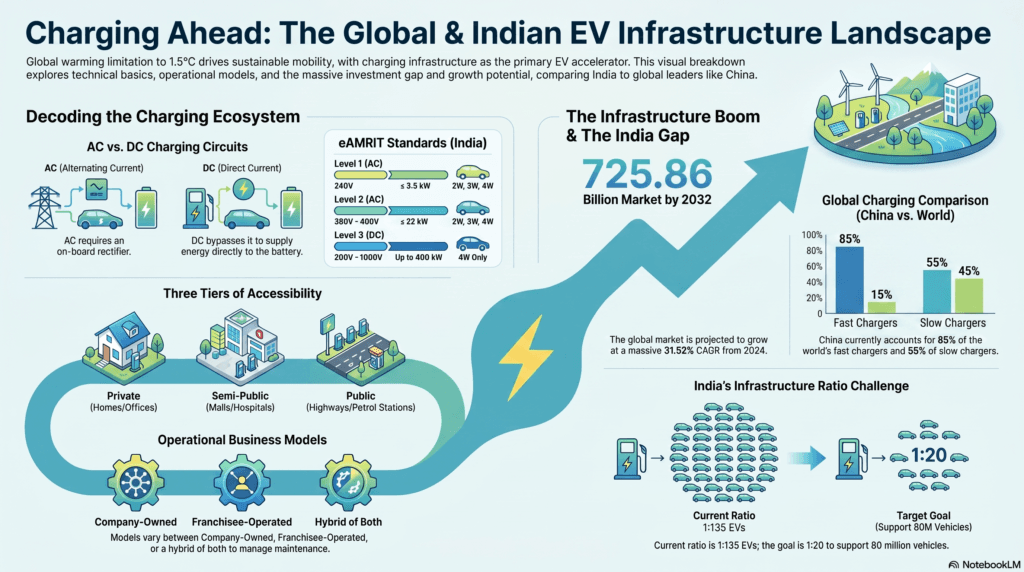
- China: China accounts for 85% of the world’s fast chargers. Their secret is standardized equipment and centralized visibility, using AI to forecast demand and optimize how fast cars charge.
How India is fighting EV Charging Chaos: The UPI for Energy
The good news is that India isn’t just copying other countries; it’s building a unique solution called Unified Bharat e-Charge (UBC) or the Unified Energy Interface (UEI).
Think of it as UPI for EV charging. Just like you can use any banking app to pay any shopkeeper, UBC will let you use any EV app to find, reserve, and pay for any charger.
This is built on the Beckn Protocol, a “common language” that allows different apps and charging stations to talk to each other.
- Discovery: You search for a charger in your favorite app, and the request is broadcast to all nearby operators.
- Booking: You can reserve a spot in advance so no one else takes it while you’re driving there.
- Payment: You pay the operator directly, likely via UPI, avoiding the need to load 20 different digital wallets.
Standardizing the Hardware: LECCS
While the apps are being unified, the physical plugs have already received an “Indian makeover”. Ather Energy developed a homegrown standard called LECCS (Type 7 connector). Before this, light EV companies used over 10 different types of plugs. Ather open-sourced their design. Their design is now a national standard recognized by the BIS that works for over 90% of India’s electric two-wheelers.
Sorting out the EV Charging Chaos: From Scale to Trust
India’s target is to have 30% of all new vehicle registrations be electric by 2030—that’s roughly 80 million EVs. To support them, we’ll need nearly 3.9 million charging stations.
But we need to move from “deployment-led” growth (just building more stations) to “reliability-led” growth (making sure they actually work). This means:
- Better Safety: New rules are needed for fire safety and audits to prevent overheating at fast-chargers.
- Smarter Grids: Using “Smart Charging” to encourage people to charge at night when electricity is cheaper and the grid is less stressed.
- Skill Building: India will need up to 200,000 skilled professionals by 2030 just to maintain this massive new network.
Conclusion
Planning an EV road trip in 2026 is still a bit of a challenge, but the pieces of the puzzle are coming together. The government is pushing for “Digital Public Infrastructure” like the India Energy Stack and projects like UBC. The day is coming when you’ll only need one app, one plug, and zero stress to drive across the country.
Until then, the best advice from seasoned owners is simple: Keep a backup plan, check the “live” status on the app before you drive, and always carry a buffer of at least 30% battery. The future is electric—it just needs a little more standardization to get there!
Simply C2 Complaints App is trying to use data from ULIP, MoPNG and encourages crowdsourcing to fill the gap in our knowledge. Try it; it’s free!