
Range anxiety isn’t about range. It’s about not knowing
Every EV conversation in India eventually lands on “range anxiety” — the fear of running out of charge with nowhere to plug in. But talk to actual EV owners and the fear isn’t really about distance. It’s about uncertainty.
Here’s the pattern: you open a map app, see a pin nearby, and drive there — only to find out on arrival that:
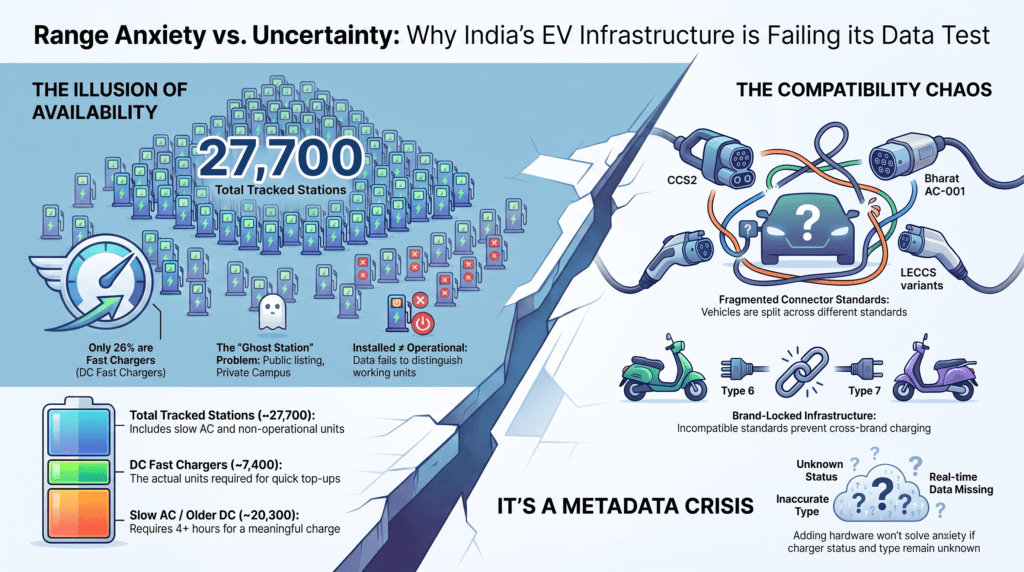
- It’s a 3.3 kW slow AC charger, and you needed a fast DC top-up in 20 minutes, not 4 hours.
- The connector is Bharat AC-001 or a proprietary two-wheeler plug, and your car needs CCS2.
- It’s “installed” but not “operational” — a distinction the data often doesn’t make.
- It’s actually inside a housing society or corporate campus, not truly public.
None of this is unique or rare. Of India’s ~27,700 officially tracked public stations, only about 7,400 are DC fast chargers — the rest are slower AC or older DC units. And the vehicle side is even messier: two- and three-wheelers alone split across Bharat AC-001, legacy Bharat DC-001, and the newer LECCS standard, which itself comes in two incompatible variants (Type 6 and Type 7) depending on the OEM. An Ola scooter and an Ather scooter literally cannot use the same charger.
So the honest failure mode isn’t “there’s no charger nearby.” It’s “there’s a charger nearby, but I have no reliable way of knowing — before I drive 15 minutes to get there — whether it’s fast or slow, whether it fits my vehicle, or whether it’s even working today.”
This is a solvable problem, but it’s not primarily a hardware problem. Adding more chargers doesn’t fix uncertainty if the metadata about each charger — power rating, connector type, live status — stays incomplete or stale. Right now, most public and private datasets record that a charging point exists, but not reliably what kind it is or whether it currently works.
Until that changes, “range anxiety” will keep showing up in survey data as a top EV concern — even in cities where, on paper, charger density looks perfectly reasonable.
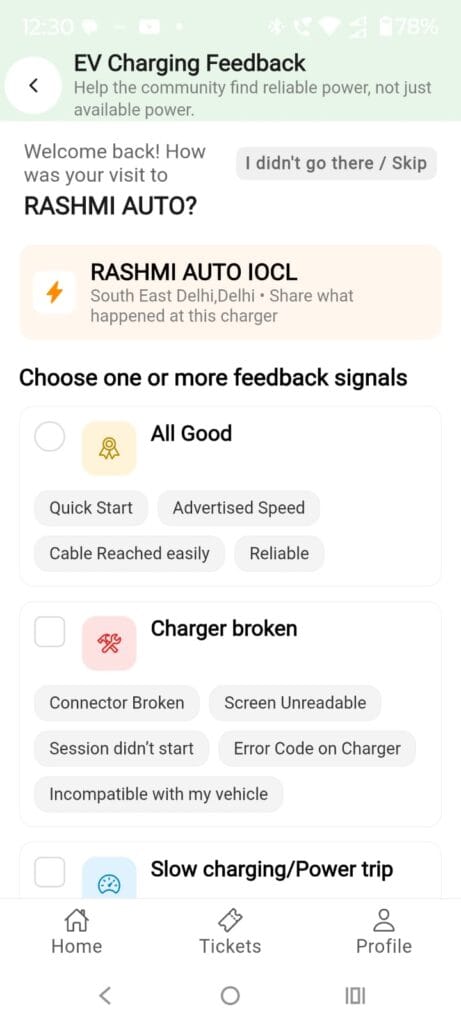
Simply C2 App for complaint logging lets you report what you see on site: do you see a charger as promised or is there scope to correct the data? Or, is it a “ghost charger”? Join us and make the experience better for everyone.