
The GOI is trying to solve India’s Charging Mess
Some misses, but many hits as well by GOI in solving India’s Charging Mess
Give credit where it’s due. The Indian government has moved to solve India’s charging mess over the last three years. The data trail shows it.

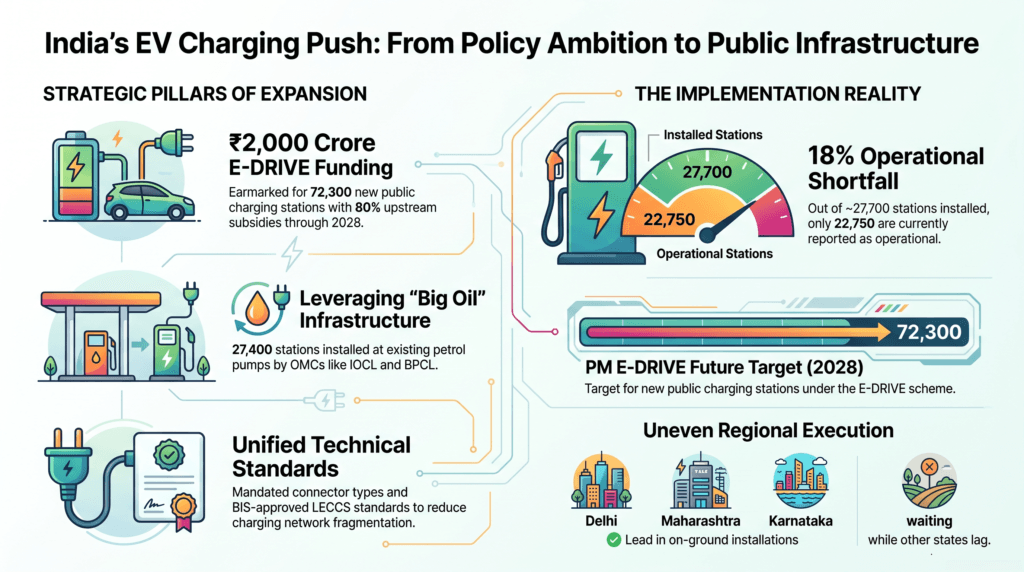
Money first. PM E-DRIVE has earmarked ₹2,000 crore specifically for 72,300 new public charging stations, with an 80% upstream subsidy to operators through March 2028. Before it, FAME-II directly funded roughly 8,900 of the stations built so far. It’s a scheme with a defined budget, a defined station target, and a defined deadline. Which is more precise than this sector has had before.
Execution through existing infrastructure. Rather than building a parallel charging network from scratch, the government leaned on assets it already controls: oil marketing companies. IOCL, BPCL, and HPCL have collectively installed roughly 27,400 stations at petrol pumps since 2021 — partly subsidised, partly self-funded — turning the existing fuel retail footprint into the backbone of the public charging network almost by default.
It’s a pragmatic move to solve India’s charging mess. Petrol pumps already have land, power connections, and nationwide distribution in exactly the pattern drivers expect fuel infrastructure to follow.
Standard-setting. The 2021 mandate requiring specific connector types at public stations, followed by BIS approval of the LECCS standard for two/three-wheelers, shows the government trying to get ahead of the fragmentation problem before it calcified — with mixed but real results (see: still needing five apps).
Transparency, sort of. Ministry data on installed vs. operational stations gets tabled in Parliament and is publicly trackable. It’s a real improvement over earlier years when even ballpark figures were hard to pin down. Businesses working in this space, including data platforms like Simply C2 that pull from government sources such as MoPNG and BEE, depend on this disclosure existing at all.
Mention must be made of The Unified Logistics Interface Platform (ULIP) that acts as a digital single-window gateway that breaks down data silos across Indian ministries and private systems. By standardizing and providing secure API access to over 30 government databases (such as VAHAN, MoPNG, SARATHI, FASTag, and ICEGATE), it enables real-time tracking, transparent verification, and paperless logistics.
Where it’s thinner. State-level execution is uneven. Delhi NCR, Maharashtra, and Karnataka have clear policy targets and visible investment. Delhi is pushing for a fast charger every 5 km. Maharashtra mandates one every 25 KM on highways. But, several states have policy documents but comparatively little on-ground installation to show for it. And the operational gap is real: of the ~27,700 installed stations tabled in Parliament, only about 22,750 are currently reported operational — a roughly 18% shortfall between “built” and “working,” which policy targets alone don’t capture.
The honest summary: India’s government has actually put both money and a coordination mechanism to solve the EV charging mess, which is more than most sectors get. But policy ambition, subsidy disbursement, and functioning infrastructure on the ground are still three different things. Closing the gap between them will matter more over the next few years than adding another headline station-count target.