

Your Products Have Memories. Why Don’t You?
Why you needed a handy product warranty tracker.
Think for a moment about all the information attached to the things you actually own. And you will soon see the point of having a product warranty tracker.
The refrigerator has a warranty, with a date it runs out. The air conditioner has an AMC – an annual maintenance contract that entitles you to a certain number of service visits. There is a schedule someone agreed to once and nobody has looked at since. The car has a service history, stamped or logged somewhere, that matters enormously the day you try to sell it. The laptop has an invoice and a warranty period. The water purifier has an installation date and a filter-change schedule that, if you’re honest, you’re not tracking at all.
Every product you own carries this kind of information. Quietly, in the background, for as long as you own it.
So, where is all of it, right now?
Where is your product warranty tracker now?
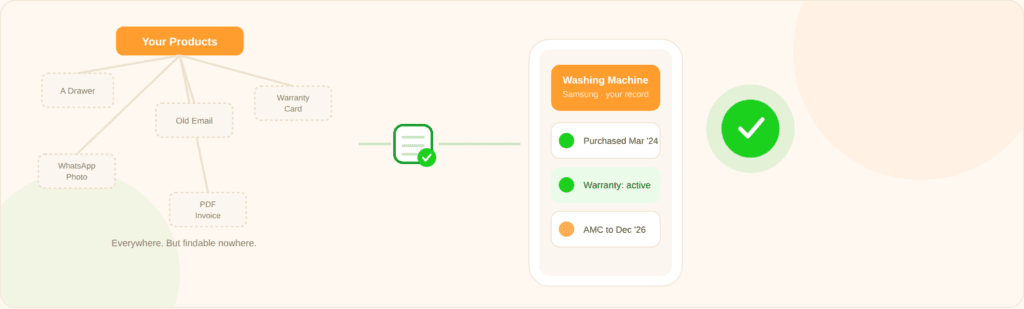
Usually, the honest answer is: somewhere. A drawer, probably, with a stack of folded paperwork nobody’s sorted in years. An email, if you’re lucky enough to still have the same address you bought it with. A WhatsApp chat with a service technician from eighteen months ago. You photographed an invoice, in case you lost the paper one. An old PDF buried three folders deep. A warranty card that, when you actually need it, nobody in the house can find.
None of this is a filing problem you’re bad at. It’s just that you never had a system to hold it. Paper warranty cards assume you’ll keep them in a fixed place forever. Email assumes you’ll remember which address, which year, which search term. None of it was built around the fact that you’ll need this information suddenly, months or years later, at the exact moment something break. Of course, which is also the worst possible moment to go looking for it.
What if your products kept their own record?
This is the idea behind the Simply C2 app, and it’s a simpler one than it might sound: keep your products together, in one place, with the information that actually matters attached to each one.
The Simply C2 App warranty vault is your product warranty tracker.
For each product, that means answering a small, specific set of questions:
- What is it?
- Which brand?
- When did I buy it?
- Is it under warranty, and until when?
- When does the AMC expire?
- Who should I contact if something goes wrong?
None of this is complicated information. It’s just information that currently lives nowhere in particular, which is functionally the same as not existing until the moment you need it and can’t find it.
From “something’s wrong” to a record that holds
Here’s where the earlier two posts in this series connect to this one. We’ve talked about the difficulty of finding the right contact for a brand, and about a directory built to solve that specific problem. But finding the contact was never the whole job – it’s the first step in something longer.
When something actually goes wrong with a product, there’s a shape to what happens next, whether or not anyone’s tracking it:
Find the right brand and support channel.
Contact the manufacturer or service provider.
Record the complaint – what was reported, and when.
Track what happens after that.
Escalate if the problem isn’t getting resolved.
That sequence is the heart of the app. It’s a small idea, but it changes what “customer support” means for the person on the other end of it. Instead of a phone call that evaporates the moment you hang up, there’s a complaint with a timestamp, attached to a product, attached to its own warranty and purchase history. Instead of relying on your memory of what the technician on the phone told you, there’s a record you can actually go back to.
This isn’t a complaint form. It’s your service record.
Here’s the point worth sitting with, because it’s easy to undersell.
A complaint form is something you fill out once and forget. What we’re describing is different. It’s a running record that belongs to the product, and by extension to you, for as long as you own it. Every warranty claim, every AMC visit, every repair, every conversation with a service center, attached to the product it happened to, searchable months or years later.
That’s a meaningfully bigger idea than “log a complaint.” It’s closer to what a good mechanic’s logbook does for a car, except it exists for the water purifier, the washing machine, and the laptop too – the products that don’t come with a service advisor keeping notes on your behalf.
None of this replaces the manufacturer’s own service process. What it does is give you, the person who actually owns the product, the same continuity of information that used to exist only inside the company’s systems, if it existed at all.
And once that record exists, the interesting part isn’t just having it – it’s watching a single problem move through it, from the Sunday morning something breaks to the day it’s actually resolved. That’s the story the next and final post in this series tells in full.
Leave a Reply