Building Simply C2 as a destination for service
Two weeks after we dropped the totally revamped Simply C2 Complaints App on the Playstore, it’s a good time to ask:
– What is Simply C2?
– What is it becoming?
Not what we said it would be when we started, but what it’s turning into, conversation by conversation, complaint by complaint. This post is mostly us thinking aloud — the paths we’ve walked, the ones we’ve turned away from, and the ones we’re still considering.
The core instinct
The instinct, underneath everything, is this: be the single place you go to when something breaks.
Not a marketplace. Not a directory. A place. The washing machine that stopped spinning, the geyser that’s leaking, the industrial compressor that’s throwing an error code. These are the moments we want to own. Our focus is India, because that’s where we understand the terrain. But the underlying problem — hardware breaks and getting it fixed is harder than it should be — isn’t an India-only problem. It’s just more acutely felt here right now.
We’ve chosen, deliberately, to focus on hardware. Whitegoods, industrial equipment, anything that comes with a warranty card and eventually needs after-sales service. Mostly breakdown. Not services in the general sense — not “get your house cleaned” or “book a beautician.” That’s a different problem, with a different trust model, and it’s already being solved by someone else.
Why we’re not Urban Company
It would be easy to describe what we do as “like Urban Company, but for appliances.” No, we are not. It’s worth explaining why.
Urban Company connects you to a third-party service provider, working under Urban Company’s brand promise, but not affiliated with the manufacturer of whatever’s broken. That’s a perfectly good model for plumbing or deep cleaning, where there is no single “brand” responsible for the outcome.
But when your refrigerator’s compressor fails, there already is a brand responsible — the one that sold it to you, under warranty or with an AMC you may have paid for. The problem isn’t a lack of technicians. It’s that reaching the right technician, the one accountable to the brand, is needlessly hard. We don’t insert a third party into that relationship. We connect you to the brand itself, and we make sure that connection is logged, tracked, and escalated if needed.
It’s a narrower promise than Urban Company’s, but a more honest one for this category — we’re making sure the company that took your money for the product answers for it.
Whether that stays true for every category we eventually touch, we don’t know yet. It’s possible “hardware breakdown” and “home services” converge someday.
Why we’re not IndiaMart, TradeIndia, or JustDial
The other comparison people reach for is the classifieds-and-leads model — IndiaMart, TradeIndia, JustDial. Post a query, get contacted by ten vendors, pick one.
We’ve decided, on purpose, not to do that. We don’t share your details with ten vendors of a product or service. We don’t sell leads. Partly this is a trust decision — nobody wants their phone to ring with sales calls after logging a complaint about a leaking geyser. But it’s also a positioning decision. The lead-marketplace model treats the customer as inventory to be monetized by matching them to demand. We’re trying to build something closer to the opposite: a record that belongs to the customer, that persists, that the brand is accountable against. That’s a slower, less immediately monetizable model. We think it’s the more durable one.
No e-commerce. Yet.
We don’t take a cut of service leads. That’s our brand promise.
There’s an obvious future where warranty tracking and complaint logging naturally lead into “and here’s where you buy the replacement part” or “here’s an AMC you can purchase directly.” We can see the shape of that business. We’re just not building it now, because we think trust must come first. And we want to guard your data with as much seriousness as you do.
What we actually provide, today
Underneath all the positioning, the product is fairly plain, and we like that it’s plain:
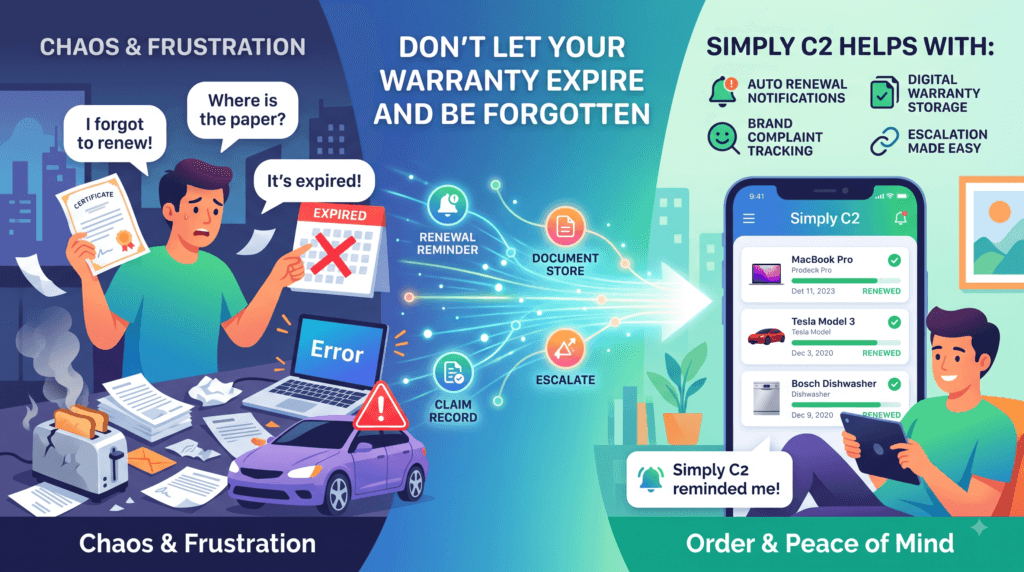
- You can store your product’s warranty details, and we’ll notify you before it expires — the thing everyone means to track and nobody does.
- You can search for a brand and log a complaint against it, and that complaint stays on record — not lost in a WhatsApp thread or a call center’s internal system you’ll never see again.
- If nothing happens in a reasonable time, you can escalate. The complaint doesn’t just sit there.
None of this is exotic. It’s closer to infrastructure than innovation — plumbing, in the boring sense of the word, for a relationship (you and the brand that sold you something) that currently has almost no plumbing at all.
The EV charging and petrol pump piece — the odd one out
And then there’s the part of Simply C2 that doesn’t obviously fit the story above: search for nearby EV charging stations and petrol pumps, and leave feedback on the service and infrastructure you find there.
We’ve agonized over this one. On the surface it’s a detour. But we think it’s actually the same underlying idea. Complain about things that are broken, stuff that you depend on. A petrol pump with a broken payment terminal and a charging station with a dead connector are, breakdowns too. We’re not sure yet whether this becomes a core pillar or stays an adjacent experiment. We’ll let the usage tell us.
Where this leaves us
We’re building toward being the place people go when hardware fails and they need the brand to make it right. We’re doing it without e-commerce, without selling leads, without inserting ourselves as a paid middleman between customer and manufacturer. How that discipline survives contact with a real business model at scale, we’ll find out. For now, it’s the bet we’re making, and we wanted to write down why.
We’ll be back soon; as we build more we will share more.